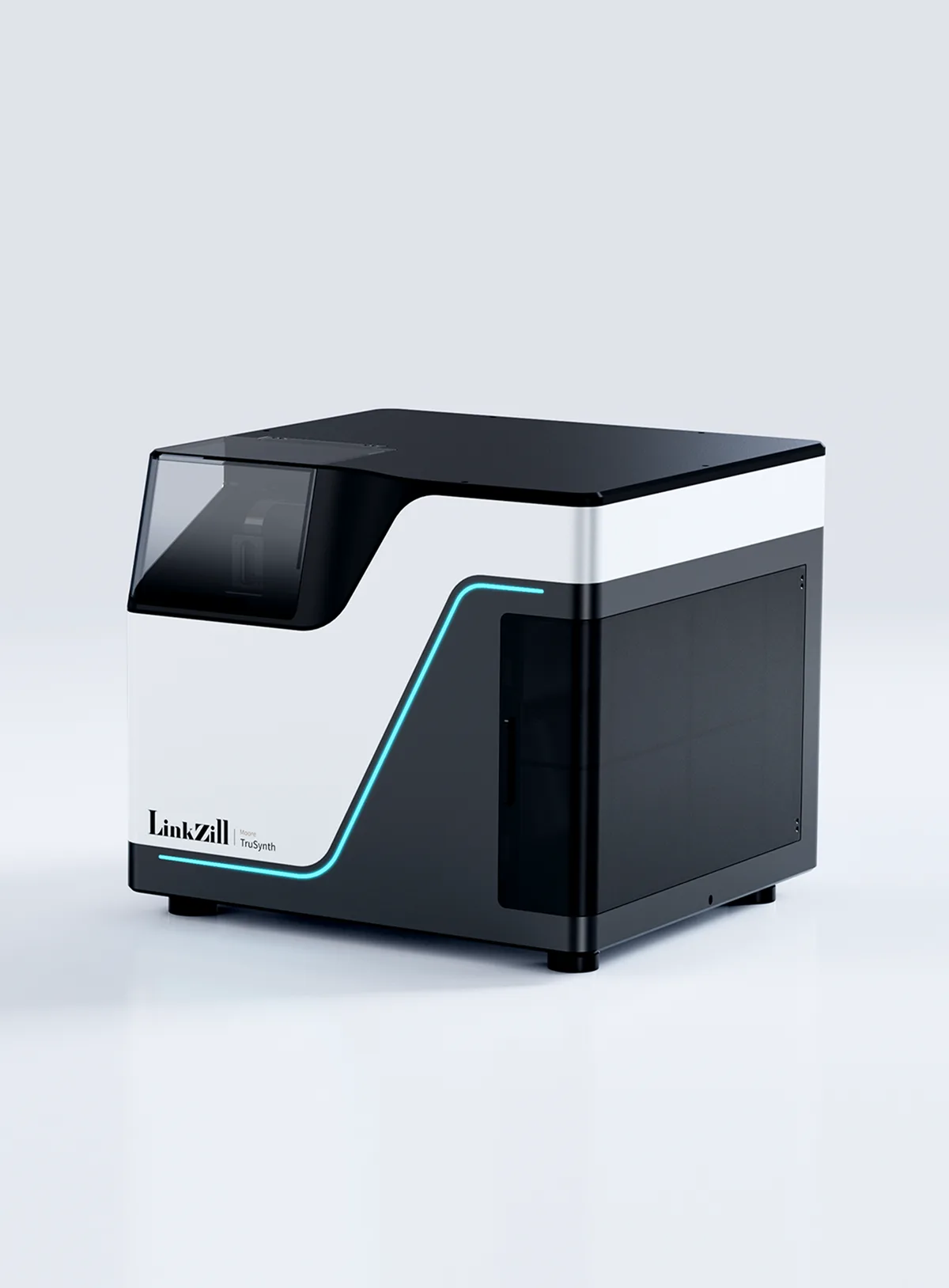


TruPool®
Sequence Template Guidelines
Template File Versions
File Format
The file is an Excel file with a single sheet. You can rename the file, but please do not modify the sheet names.
Oligo_ID_and_Seq sheet
The index number for each oligonucleotide
0 represents a demo oligo; 1 to 4,096/65,536 represents the sequences to be synthesized. Do not modify, add, or delete anything in this column.
The name of each oligonucleotide
equivalent to the content after “>” in FASTA format.
The sequence of each oligonucleotide
The default is 1.
Filling and Validation Rules
Oligo_ID_and_Seq sheet
- Must be continuous, non-repeating positive integers.
- Should not be modified.
- If you do not wish to set names, you may leave the entire column blank (IDs will be assigned automatically); however, you can not fill some rows and leave others blank.
- Duplicate Oligo_IDs are not allowed .If a sequence needs to be synthesized multiple times, please set the Redundancy instead of duplicating the row.
- Allowed characters:Uppercase and lowercase letters (A-Z, a-z), Arabic numerals (0-9), and certain symbols (+-=_.:). Spaces, full-width characters (including Chinese), line breaks, tabs, and other special characters are prohibited.
- Due to limitations in most bioinformatics software, the first character of the Oligo_ID must be a letter (A-Z, a-z) and cannot be a number or special character.
- Allowed characters:Letters (A-Z, a-z) and Arabic numerals (0-9).
- Unless there are special requirements, use uppercase A、C、G、T for natural bases,By default,lowercase letters will be converted to uppercase.
- Uppercase R、Y、S、W、K、M、B、D、H、V、N represent condensed bases,By default, lowercase letters will be converted to uppercase.
- You may use N for random condensed bases,However, if you need to synthesize non-N condensed bases (e.g., R, Y, S, W, K, M, B, D, H, V), please contact our customer manager for clarification and confirmation.
- Characters other than A, C, G, T, R, Y, S, W, K, M, B, D, H, V, N (including numbers) may represent special monomers, specific synthesis recipe, or modification groups. If required, please contact our customer manager.
- If your lower- and uppercase letters represent different monomers or recipes, please contact our customer manager.
- Must be a positive integer.
- If left blank, the default value is set to 1.
- The sum of the Redundancy column should not exceed the throughput limit (e.g., 4,096 or 65,536).
Additional Suggestions and Rules
In the Oligo_ID_and_Seq sheet, each row represents one unique oligonucleotide sequence. For example, if a user needs to synthesize 1,800 different sequences using a 4K chip with 2 copies of each, they should fill rows with Oligo_No 1 to 1,800 and set Redundancy to 2, rather than filling rows with Oligo_No 1 to 3,600.
The row where Oligo_No is “0” and Oligo_ID is “Demo_Oligo” is an example row. Please do not modify it. This row is not synthesized and will not appear in the final product.
In principle, Oligo_Seq should correspond one-to-one with Oligo_ID. A single Oligo_ID can only correspond to one Oligo_Seq. While different Oligo_IDs corresponding to the same Oligo_Seq are permitted, we recommend verifying your design.
Avoid cases where Oligo_ID is empty while Oligo_Seq contains data.
Product Quality Related Tips
If you have certain requirements for product yield or if downstream experiments involve amplification, we strongly recommend including universal primer sequences.
Within an oligo pool or subpool amplified with the same primer pair, significant differences in sequence length may cause variations in synthesis yield and significant amplification bias, affecting the uniformity of the product.