
TruArray®
Oligonucleotide Microarray

A biochip with flexible array sizes

TruArray®
Oligonucleotide Microarray

A biochip with flexible array sizes

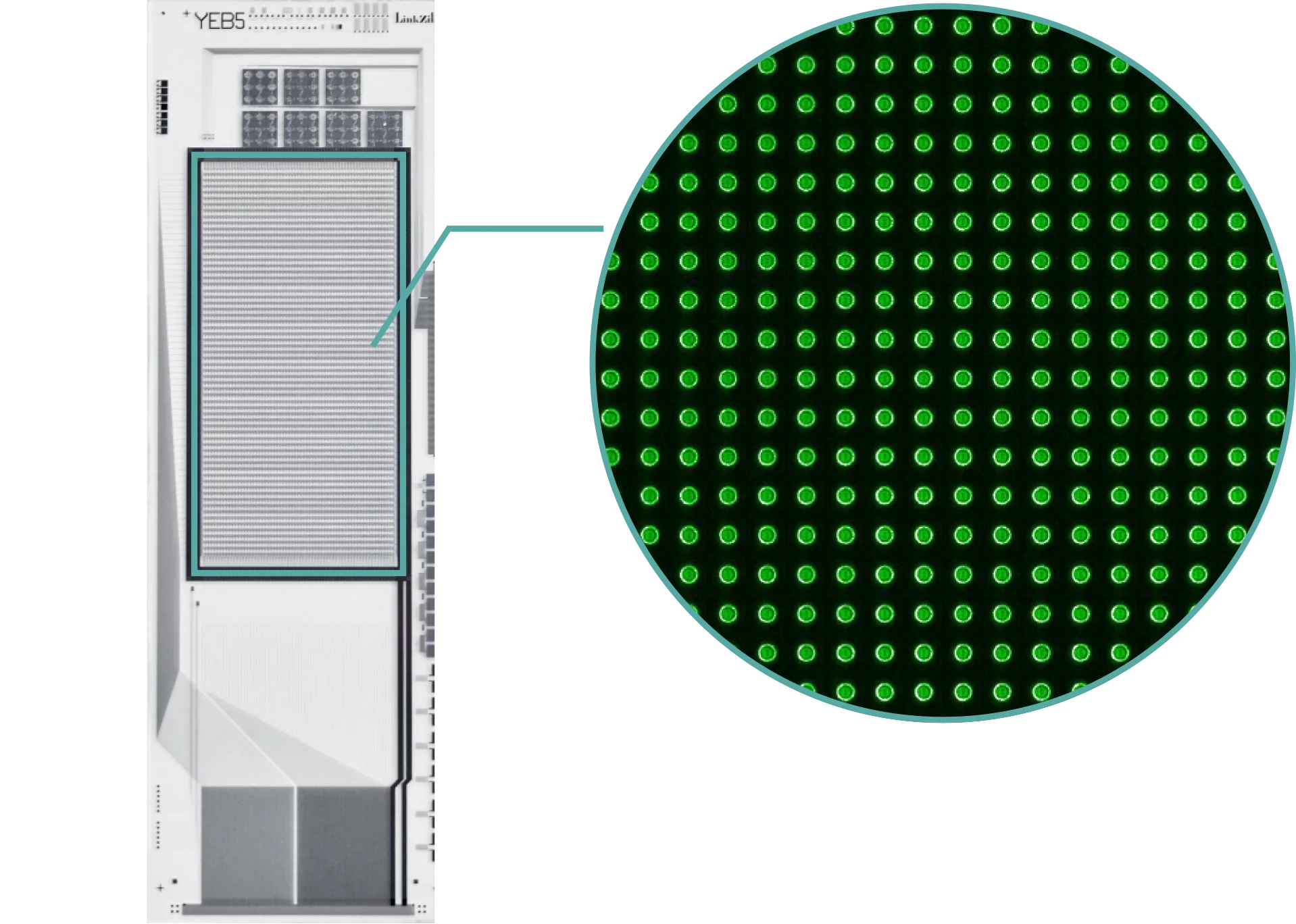
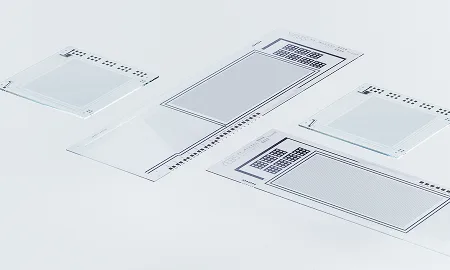
An oligonucleotide microarray, also known as a DNA/RNA/XNA chip,
consists of arrayed spots attached to a solid surface (such as glass, silicon, or a TFT semiconductor chip),
and each spot contains specific single-stranded oligonucleotide probes.

An oligonucleotide microarray, also known as a DNA/RNA/XNA chip, consists of arrayed spots attached to a solid surface (such as glass, silicon, or a TFT semiconductor chip), and each spot contains specific single-stranded oligonucleotide probes.

Highlights

Flexible array size

Support for
chip customization [1]

  • Flexible and customizable spot size, within one chip

Flexible partitioning

  • 4K and 59K microarrays with 16 partitions are available
  • Partitioning schemes are customizable

High precision [2] [3]

  • Coverage up to >99.9%
  • Error rate down to <0.4%/nt

High inter-spot oligoprobe amount uniformity [2] [3]

  • Q95:Q5<1.2X
  • Q99.5:Q0.5<1.5X

Support for sequence customization [1]

  • Support for condensed bases
  • Support for special monomers
  • Support for 5′ modifications

Low barriers to customization

  • Microarray customization costs as low as the $1,000 level

Application Scenarios

  • Pathogen and resistance screening
  • Pharmacogenetics
  • Germplasm identification
  • High-throughput aptamer discovery
  • Genomic variant genotyping
  • Gene expression profiling
  • In situ spatial OMICs
  • Non-mass-spectrometric proteomics
  • Sequencing technology
  • In situ gene synthesis
  • Solid-phase capture
  • Medical diagnostics

Product Category

Product Category Delivery
Form
Available
Customization
Oligo
Length
Chip
Dimensions
Array Size Turnaround
Time
TruArray®
Std
• DNA microarray chip,
3'-end coupled to the
chip surface [1]

• XNA microarray chip,
3'-end coupled to the chip surface [1]
• Condensedbase [1]
• Special monomer [1]
• 5'-modification [1]
10~150nt [4] 75.20mm
×
25.4mm
4K Chip:
Up to 4,096 oligos per chip
5~10
working days
4K Partitioned Chip:
Up to 4,096 oligos and
16 partitions per chip
65K Chip:
Up to 65,536 oligos per chip
59K Partitioned Chip:
Up to 59,392 oligos and
16 partitions per chip
16K/32K/120K/0.5M Chip:
Coming soon [1]
Product Category TruArray® Std
Delivery Form DNA microarray chip, 3'-end coupled to the chip surface [1]
XNA microarray chip, 3'-end coupled to the chip surface [1]
Available Customization • Degenerate base [1]
• Special monomer [1]
• 5'-modification [1]
Oligo Length 10~150nt [4]
Chip Dimensions 75.0mm×25.4mm
Array Size 4K Chip: Up to 4,096 oligos per chip
4K Partitioned Chip: Up to 4,096 oligos and 16 partitions per chip
65K Chip: Up to 65,536 oligos per chip
59K Partitioned Chip: Up to 59,392 oligos and
16 partitions per chip
16K/32K/120K/0.5M Chip: Coming soon [1]
Turnaround Time 5~10 working days

Specifications

Array Size Up to 4,096 or 59,392 / 65,536 per chip
Partition Number and Size
4K chip supports 16 partitions,
each containing up to 256 oligos
59K chip supports 16 partitions,
each containing up to 3,712 oligos
Oligo Length Up to 150 nt
Coverage >99.5%
Error Rate < 0.8% / nt
Inter-spot Uniformity • > 90% of oligos represented within < 2.0X of the median
• > 99% of oligos represented within < 3.0X of the median
Available Special Monomers • Condensed base
• Special monomer
Turnaround Time 5~10 working days
Array Size Up to 4,096 or 65,536 per chip
Partition Number and Size • 4K chip supports 16 partitions, each containing up to 256 oligos
• 59K chip supports 16 partitions, each containing up to 3,712 oligos
Oligo Length Up to 150 nt
Coverage >99.5%
Error Rate <0.8%/nt
Inter-spot Uniformity • >90% of oligos represented within <2.0X of the median
• >99% of oligos represented within <3.0X of the median
Available Special Monomers • Condensed base
• Special monomer
Turnaround Time 5~10 working days

TruArray® Ordering Process

Place Order

Confirmation

Production

Quality Control

Delivery

Place
Order

Confir-
mation

Produc-
tion

Quality
Control

Delivery

Template File Versions

4K Throughput, without standard QC sequences
Fills up to 4,096 sequences
Download
4K Throughput, with QC sequences
Fills up to 4,000 sequences
Download
65K Throughput, without QC sequences
Fills up to 65,000 sequences
Download
65K Throughput, with QC sequences
Fills up to 65,536 sequences
Download
TruArray®
Sequence Template Guidelines

Contact

[1] For availability and specific requirements, please consult our customer service manager.

[2] Measured with 65K-throughput DNA microarrays at the length of 150 nt. The DNA microarrays contain 130 nt of random sequences and 20 nt of common sequences at the 5' end. We used the FISH fluorescence signal intensities for this statistic.

[3] Differences in oligo sequence and microarray design may also affect specifications such as coverage, uniformity, precision, etc.

[4] Please consult our customer service manager if you are interested in microarrays exceeding 150 nt in length.

Dr. Kang Kang

Partner & CBio

Dr. Kang received his Ph.D. in Bioinformatics and Systems Biology from the University of Hong Kong in 2018, then became a scientific co-worker of the Leibniz Association (Leibniz-HKI) and a visiting scientist at the Novo Nordisk Foundation Center for Biosustainability (DTU Biosustain) at the Technical University of Denmark. He was a scientist at BGI-Shenzhen and co-founded the synthetic biology research group. He was a senior bioinformatics engineer and brand advisor at WeGene. In 2021, Kang joined Biosysen Limited as a co-founder and served as Chief Informatics Scientist. He is also an advisor and author of the biotech media "Regenesis". He has been dedicated to the R&D and industrialization of OMICs technologies, high-throughput technologies, and synthetic biology for over 10 years. He joined LinkZill in March 2023, responsible for semiconductor life science tools and product planning.

康康   博士

合伙人兼首席生物信息官

博士毕业于香港大学生物信息和系统生物学专业,后任德国莱布尼茨协会科学合作者、丹麦科技大学诺和诺德生物可持续研究中心访问科学家。曾先后担任华大基因科学家,参与创立了华大基因合成生物学研究方向;微基因资深生物信息工程师、品牌顾问;倍生生物联合创始人兼首席信息科学家。他专注于合成生物学、组学和高通量技术10余年,同时也是生物技术领域颇具影响力的「行业KOL」。2023年3月加入领挚科技,负责半导体生命科学工具方向与产品规划。