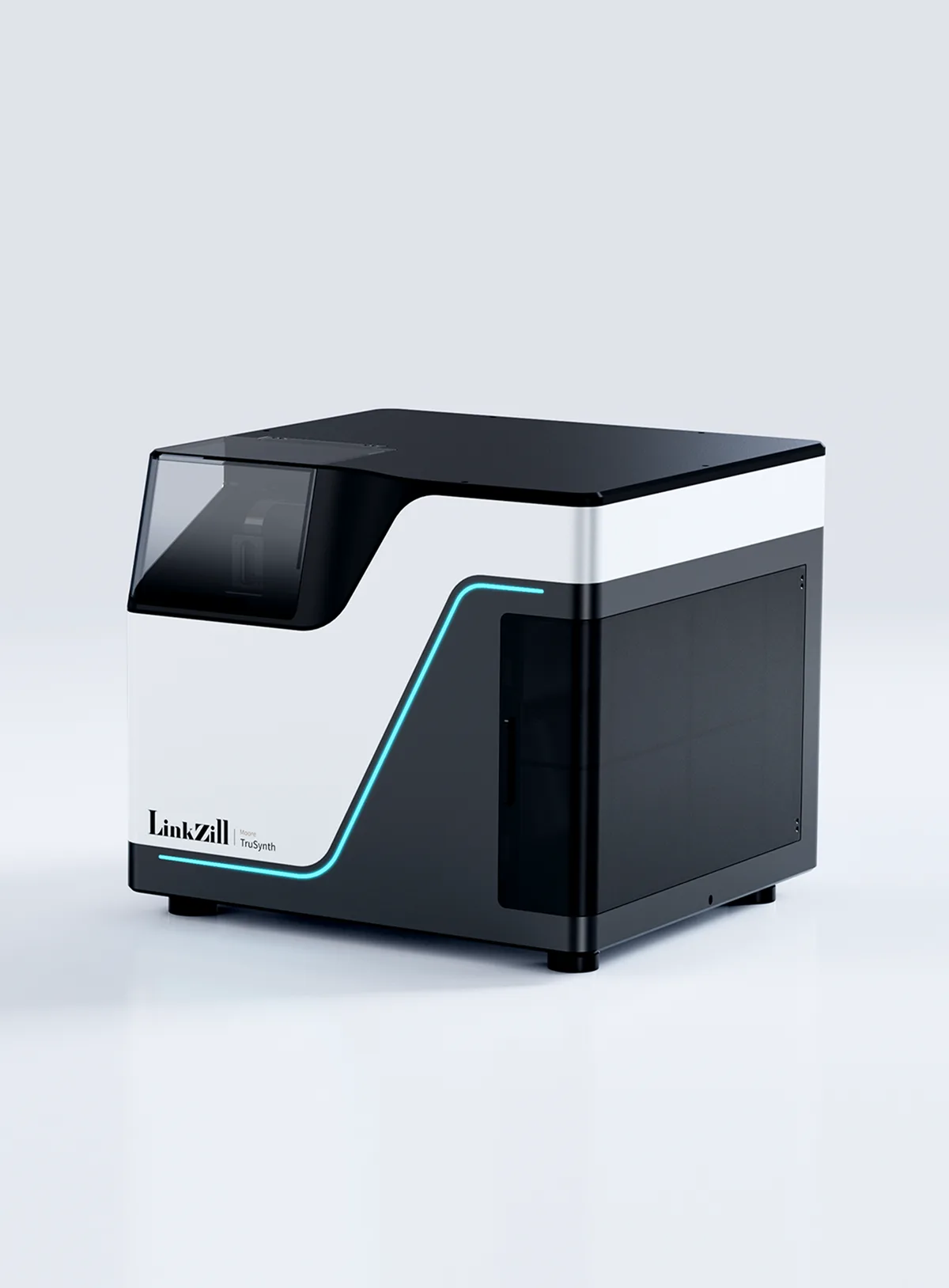
LinkZill Introduces the New TruSynth® Base and TruSynth® Moore
-scaled.webp)
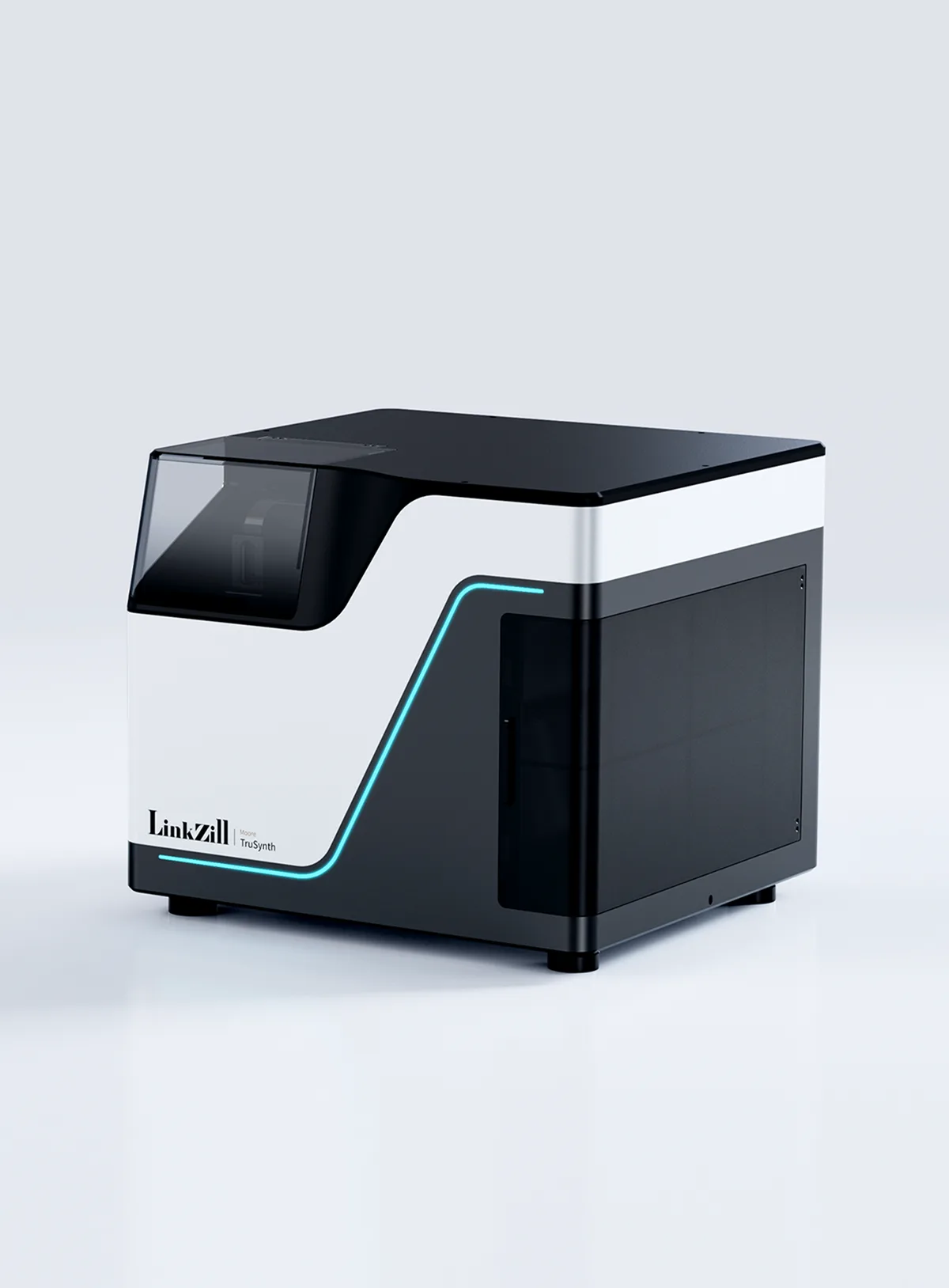
LinkZill has upgraded its oligonucleotide microarray synthesis platform with the launch of two new benchtop systems: TruSynth® Base and TruSynth® Moore, both now available for pre-order.
TruSynth® Base is the entry-level model. Its name refers both to a technological foundation and to nucleobases. The system supports the four standard DNA monomers—A, C, G, and T—meeting the needs of conventional DNA microarray and oligonucleotide-pool synthesis. Compact and flexible, it is approximately the size of a standard desktop printer.
TruSynth® Moore, the flagship model, is designed as a high-speed synthesis engine for AI-driven life sciences. In addition to standard DNA synthesis, it features six additional reagent bottle positions. These enable the incorporation of RNA, methylated, LNA, and other non-standard monomers, as well as 5′ modifications and degenerate bases at user-defined ratios.
The name “Moore” also echoes “more”: more monomer ports, an expanded sequence design space, and more possibilities. Without increasing chip size or reducing throughput, the system can significantly expand the diversity of oligonucleotide pools—bringing a Moore’s Law-like effect to biological sequence generation.
By supporting special monomers, on-chip modifications, and arbitrary-ratio degenerate bases in a benchtop oligonucleotide microarray synthesizer, TruSynth® Moore addresses several major limitations of existing microarray and oligonucleotide-pool synthesis services.
New Capabilities: Expanding the Biological Sequence Space
Specialized monomers are increasingly important in nucleic acid drug discovery, aptamer development, genotyping, point-of-care testing, proteomics, and DNA data storage.
For example, phosphorothioate, 2′-OMe, 2′-MOE, and 2′-F monomers can improve the stability of RNA therapeutics and aptamers by increasing resistance to nuclease degradation. Modified deoxyuridines such as BndU, NapdU, and TrpdU can mimic hydrophobic amino acid side chains, expanding the chemical diversity available for aptamer screening.
LNA monomers can strengthen nucleic acid hybridization in genotyping and diagnostic applications. Methylated monomers and RNA monomers may also expand the base alphabet for nanopore sequencing and DNA data storage, potentially increasing information density without changing chip throughput.
TruSynth® Moore also supports a range of 5′-end modifications:
– Biotin and digoxigenin can facilitate oligonucleotide-pool purification and capture-probe preparation.
– 5′ phosphorylation enables direct enzymatic ligation, supporting applications such as large-scale in situ gene synthesis and potentially in situ protein expression and screening.
– Fluorescent modifications can provide positive controls and quality-control spots for hybridization and genotyping microarrays.
– Amino, thiol, alkyne, and related modifications support attachment to glass, metal electrodes, or other molecules through coupling and click-chemistry reactions.
Another major capability is the synthesis of degenerate bases at arbitrary ratios, which can substantially expand the sequence capacity of an oligonucleotide pool.
In AI-assisted protein design, oligonucleotide pools can be used to build libraries containing hundreds to hundreds of thousands of rationally designed sequences. Scanning, saturation, and combinatorial mutant libraries can then generate thousands or millions of standardized perturbation data points.
When the required design space exceeds the direct throughput of a synthesis chip, NNK codons and other user-defined degenerate bases can expand the library into the millions or even billions of variants.
Consecutive N bases can also generate unique molecular identifiers and sequencing adapters, helping identify individual molecules, reduce bias, detect contamination, and support ultra-sensitive variant analysis. In DNA data storage, different base compositions and ratios can encode additional signal states, further increasing storage density.
Improved Synthesis Quality
LinkZill has upgraded the complete synthesis workflow, including instrumentation, proprietary reagents, synthesis chips, process control, and built-in algorithms.
As a result, the platform now achieves:
– Single-base error rate down to < 0.4% / nt – Coverage > 99.9%
– Pre-amplification uniformity: Q95:Q5 < 2.0×
– Post-amplification uniformity as low as below 3.0X
These specifications place the platform among the industry leaders in China.
New 65K and Partitioned Synthesis Chips
-scaled.webp)
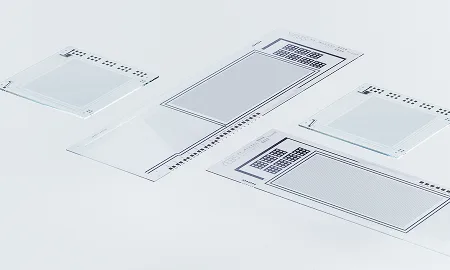
LinkZill has also introduced several new TFT-DNA synthesis chips.
The new 65K chip can synthesize up to 65,536 distinct sequences on a single chip. The company is also launching 4K and 59K partitioned chips, each divided into 16 physical partitions aligned with the spacing of a 384-well plate. Each partition can synthesize up to 256 or 3,712 distinct sequences, respectively.
Physical partitioning naturally separates samples and enables independent processing of oligonucleotide subpools. This improves throughput flexibility, reduces the complexity of individual pools, and allows sequences with different characteristics—such as GC content or secondary structure—to be separated for more targeted downstream processing.
Partitioned chips are particularly suited to applications with variable throughput requirements or an inherent need for independent subpools. Potential use cases include NGS capture panels, personalized minimal residual disease testing, and massively parallel gene synthesis.
A New Data Engine for AI in Life Sciences
AI-assisted sequence design, particularly protein design, has become one of the most important directions in modern life sciences.
Existing models have achieved major breakthroughs in protein structure prediction. However, moving from structure prediction to reliable functional design—and from general affinity prediction to the design of specific proteins and enzymes—will require far more standardized sequence-function data.
Such datasets must be generated through large-scale, reproducible construction and testing. High-throughput DNA synthesis is the starting point of that process.
In protein and nucleic acid engineering, combining AI-based scaffold design with mutant libraries creates a powerful model of “rational design plus directed evolution.” This approach is already accelerating the development of antibodies, nanobodies, binders, enzymes, aptamers, and nucleic acid therapeutics.
As general-purpose biological models become more powerful and accessible, competitive advantage will increasingly depend on the ability to construct large perturbation libraries at low cost, generate standardized experimental data rapidly, and use that data to build proprietary models.
With TruSynth® Moore and TruSynth® Base, LinkZill aims to provide foundational synthesis tools and data engines for the AI for Life Sciences era.
To learn more or register your interest, visit: https://order.linkzill.com/dna_synthesizer or contacht us at info@linkzill.com